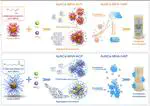
Researchers from Wuhan University of Technology, in collaboration with Peter Fratzl from the Max Planck Institute of Colloids and Interfaces, designed carboxyl-functionalized gold nanoclusters as novel noncollagenous protein analogues and revealed for the first time the decisive regulatory role of ligand chain length-dependent interfacial properties on collagen mineralization patterns: short-chain ligands stabilize liquid precursors for intrafibrillar mineralization, while long-chain ligands promote rapid extrafibrillar mineralization. This study provides molecular-level insights for the design of biomimetic high-performance bone repair materials.