Synergistic Antibacterial Remineralization: A Bioprocessing-Inspired Single-Step Nanoparticle-Induced Liquid Precursor Strategy for Functional Dentin Repair
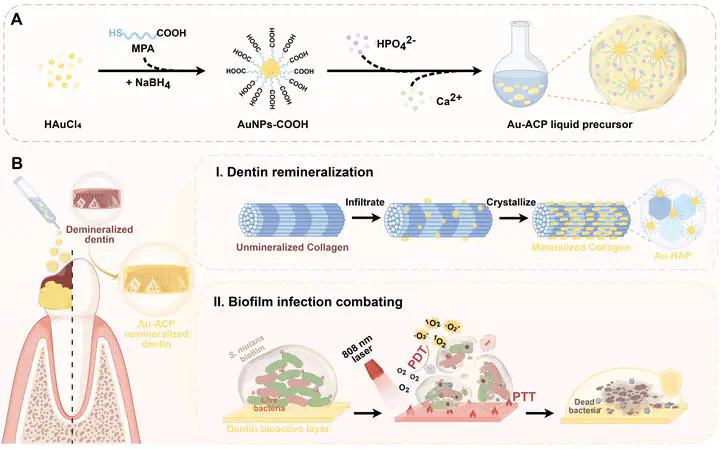
Recently, Zhaoyong Zou, Zhengyi Fu, Guanbin Gao, and Luyao Yi from Wuhan University of Technology, inspired by the crucial regulatory role of noncollagenous proteins (NCPs) in dentin biomineralization, designed carboxyl-functionalized gold nanoparticles (AuNPs-COOH) as novel NCP analogues and constructed a nanoparticle-induced liquid precursor (NILP) system that synergistically achieves biomimetic dentin remineralization and antibacterial functionalization. These “smart gold beans” not only stabilize amorphous calcium phosphate (ACP) precursors but also guide them into the collagen fibrils of demineralized dentin, achieving intrafibrillar mineralization and reconstructing the hierarchical dentin network. The NILP-repaired dentin exhibits mechanical properties comparable to healthy dentin, along with near-infrared (NIR) light-responsive long-lasting antibacterial properties and excellent biocompatibility. This study breaks through the limitations of conventional repair materials that are functionally single and procedurally cumbersome, integrating structural repair and biological protection into one step, providing a novel solution for dental caries treatment. The related work was published in ACS Nano under the title “Synergistic Antibacterial Remineralization: A Bioprocessing-Inspired Single-Step Nanoparticle-Induced Liquid Precursor Strategy for Functional Dentin Repair” (First authors: Luyao Yi and Jielong Gao).
Research Background
Dental caries, as the third most common disease globally, not only affects patients’ quality of life but also imposes a heavy burden on society. Dentin is the main supporting structure of teeth. Once eroded by bacteria, it can cause sensitivity, pain, and may even progress to pulpitis, periapical periodontitis, and systemic infections. Restoring dentin structure and enhancing its biological stability against adverse stimuli are crucial for caries treatment and oral–systemic health. Interestingly, in nature’s exquisite blueprint, dentin formation is a precisely regulated process in which NCPs play key roles as “guides” and “architects,” directing hydroxyapatite (HAP) to deposit in a highly ordered manner within the nanoconfined spaces of type I collagen fibrils. This precise mineralization mechanism ultimately endows dentin with excellent mechanical properties combining hardness and toughness. For decades, researchers have attempted to repair damaged dentin by mimicking natural biomineralization processes. However, classic organic NCP analogues such as polyaspartic acid, while effectively inducing dentin remineralization, still suffer from insufficient mechanical strength and biological activity, making them prone to “secondary caries.” Therefore, there is an urgent need to develop an in situ repair technology that breaks through the dual barriers of “structural reconstruction” and “antibacterial functionalization,” achieving structure–function integration in repaired dentin.
Key Findings
1. AuNPs-COOH Induce Liquid Precursor Formation and Intrafibrillar Mineralization
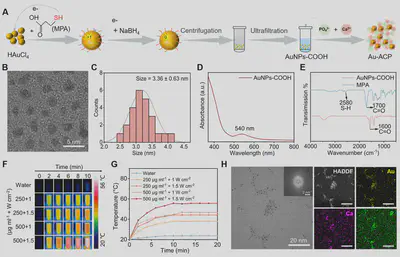
To test the bold hypothesis that nanoparticles could mimic the biological functions of NCPs, the researchers designed and synthesized carboxyl-functionalized gold nanoparticles with a size of approximately 3.4 nm and added them to a mineralization solution containing calcium and phosphate ions. The results showed that these “gold beans” could not only stabilize ACP mineralization precursors like natural NCPs but also actively guide them to infiltrate into collagen fibrils, achieving intrafibrillar mineralization. Thus, the classic polymer-induced liquid precursor (PILP) mineralization strategy was further innovated into the nanoparticle-induced liquid precursor (NILP) mineralization strategy.
2. Au-ACP Remineralized Dentin Restores Mechanical Properties
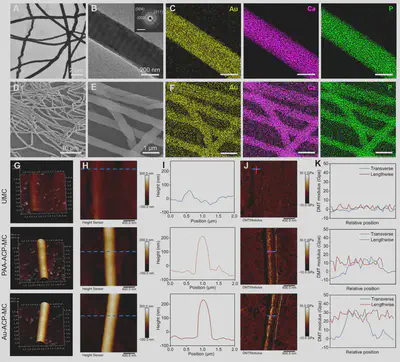
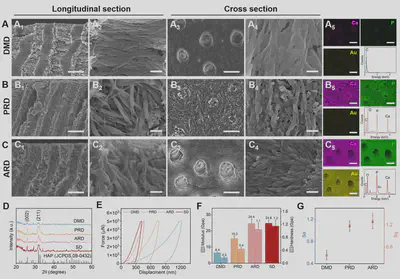
When the Au-ACP “magic potion” was applied to a demineralized dentin model, it perfectly replicated the hierarchical structure of natural dentin. Moreover, due to the incorporation of AuNPs-COOH within the mineralized collagen fibrils, the remineralized dentin exhibited mechanical properties consistent with natural dentin (elastic modulus of 24.4 GPa and hardness of 1.1 GPa), representing an improvement of more than 40% over conventionally polymer-induced remineralized dentin.
3. Au-ACP Remineralized Dentin Exhibits NIR-Responsive Antibacterial Activity
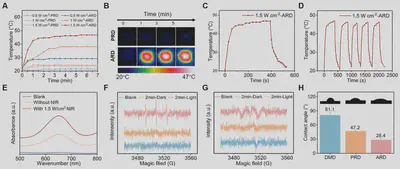
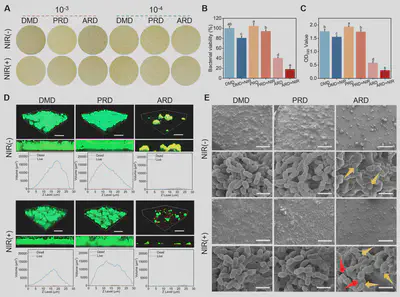
More interestingly, AuNPs-COOH serve not only as “construction workers” but also as “antibacterial guards.” Their localized surface plasmon resonance effect enables the remineralized dentin to possess a “dual antibacterial buff”: photothermal effect and photodynamic effect under NIR irradiation. Through the synergistic action of thermal energy and reactive oxygen species, it precisely kills Streptococcus mutans, the primary cariogenic bacterium. Experiments showed that under NIR irradiation, the bacterial biofilm on Au-ACP remineralized dentin was reduced to 10–20% of that in the control group, demonstrating significant long-lasting antibacterial effects.
Outlook
From learning from nature to surpassing nature, this study demonstrates the tremendous potential and broad application prospects of bioprocessing-inspired material preparation technologies. Here, AuNPs-COOH serve not merely as carriers but as functional enablers and process regulators. By inducing the synthesis of the Au-ACP “magic potion,” it combines structural repair and biological defense into a single step, simplifying complex multi-step procedures into a one-step operation. This provides a novel concept for the development of functionalized dental restorative materials and opens a new door for the exploration of intelligent biomaterials.
Publication Information
Luyao Yi, Jielong Gao, Zhengrong Yin, Cui Huang, Taolei Sun, Guanbin Gao, Zhengyi Fu, and Zhaoyong Zou, Synergistic Antibacterial Remineralization: A Bioprocessing-Inspired Single-Step Nanoparticle-Induced Liquid Precursor Strategy for Functional Dentin Repair. ACS Nano 2025, 19 (50), 42419–42435. https://doi.org/10.1021/acsnano.5c14982


Zhaoyong Zou
Professor
My research interests include bioprocess inspired fabrication, crystallization and ceramics.

Zhengyi Fu
Academician of the Chinese Academy of Engineering
Academician of the Chinese Academy of Engineering, Professor at Wuhan University of Technology.
Guanbin Gao
Professor
Professor at Wuhan University of Technology, specializing in nanobiomedical materials.