slug = “20251023-pub-tuning-stability-crystallization-afm”
title: ‘Tuning the Stability and Crystallization Pathway of Georgeite via Solution Parameters’ subtitle: ’' date: 2025-10-23T12:00:00+08:00 summary: ‘Researchers from Wuhan University of Technology systematically investigated the stability and crystallization pathways of amorphous basic copper carbonate (ABCC/georgeite) under heating in air and in solution, revealing that the stability and crystallization kinetics of ABCC are predominantly controlled by the solution environment after its formation. Higher pH significantly enhances ABCC stability by inhibiting nanoparticle aggregation and rearrangement, challenging the classical supersaturation-centric view of crystallization. Published in Advanced Functional Materials.’ draft: false featured: true authors:
- zikuan-wei
- qihang-wang
- zhaoyong-zou
- zhengyi-fu lastmod: 2025-10-23T12:00:00+08:00 tags:
- Amorphous Materials
- Basic Copper Carbonate
- Georgeite
- Crystallization Pathway
- Solution Parameters
- Non-classical Crystallization
- Stability Control
- In-situ Characterization categories:
- publication projects: [] image: caption: ’' focal_point: ’' preview_only: false filename: featured.jpg
On October 23, 2025, the research team led by Researcher Zhaoyong Zou from Academician Zhengyi Fu’s group at the State Key Laboratory of Advanced Technology for Materials Synthesis and Processing, Wuhan University of Technology, published their findings entitled “Tuning the Stability and Crystallization Pathway of Georgeite via Solution Parameters” in Advanced Functional Materials.
1. Research Background
Over the past decade, numerous studies have demonstrated that amorphous materials exhibit tremendous potential in applications such as catalysis, batteries, and wastewater treatment. Their advantages include: (1) unique microstructure and abundant active sites providing excellent reactivity; (2) controllable synthesis and modification under relatively mild conditions, allowing them to adapt more easily to different reaction environments; and (3) superior plasticity and formability expanding their potential applications. In addition, amorphous materials have been widely used as precursors for the fabrication of crystalline materials with intricate hierarchical structures and excellent properties—a well-known phenomenon in biomineralization. However, amorphous materials are thermodynamically unstable, and their stability is often less than satisfactory.
During the past decades, our understanding of non-classical crystallization mechanisms has evolved substantially. Taking calcium carbonate as an example, the crystallization process of amorphous calcium carbonate (ACC) in supersaturated solutions is a typical case of dissolution and recrystallization. In the presence of additives, the crystallization of ACC can also proceed via particle attachment, solid-state transformation, pseudomorphic transformation, or a combination of several crystallization pathways, which brings huge challenges to fully understanding the underlying crystallization mechanism. These non-classical crystallization pathways, partially inspired by biomineralization processes, have attracted tremendous interest and show broad implications from fundamental understanding of crystallization mechanisms to bioprocessing-inspired fabrication of advanced materials.
Basic copper carbonate (BCC), or malachite, is a widespread copper mineral that serves as a functional material in various fields such as catalysis, biomedicine, wastewater treatment, and batteries. It can also be used as a precursor for other functional materials like CuO. BCC is often synthesized by co-precipitation in solution, and BCC crystals with various morphologies can be obtained under different conditions. Previous studies have shown that georgeite, an amorphous basic copper carbonate (ABCC) phase, exists as a transient metastable precursor during crystallization of BCC, and it can serve as a precursor for the preparation of highly active copper-based catalysts. However, surprisingly, little is known about the stability and crystallization pathways of georgeite, which are critical aspects for its industrial applications.
2. Research Content
The team systematically investigated the stability and crystallization processes of ABCC under heating in air and in solution, utilizing an automatic potentiometric titrator to monitor changes in pH and Cu²⁺ concentration, combined with XRD, SEM, TEM, Raman spectroscopy, and other characterization techniques.
Synthesis and Characterization of ABCC at Different Concentrations
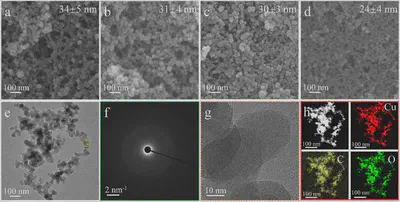
ABCC was synthesized by fast addition of CuCl₂ solution to Na₂CO₃ solution, with initial theoretical concentrations varying from 5 mM to 40 mM. SEM images showed that ABCC samples collected 10 s after reaction were spherical nanoparticles, with average particle size decreasing slightly from 34±5 nm (5 mM) to 24±4 nm (40 mM). This decreasing particle size with increasing concentration was similar to that observed for ACC, likely due to increased solution supersaturation associated with higher initial concentrations, resulting in fast spontaneous phase separation. TEM images revealed branched chain-like aggregates of nanospheres. SAED and HRTEM confirmed the amorphous nature, while EDX mapping showed uniform distribution of Cu, C, and O elements.
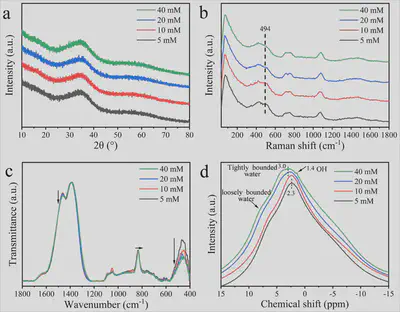
XRD patterns showed only broad humps at ≈35° and ≈55°, confirming the amorphous nature of all samples. Raman and FTIR spectra showed typical vibrational bands similar to BCC, but with subtle differences: the peak at 494 cm⁻¹ gradually weakened with increasing concentration, and the relative intensity of peaks at 1474 cm⁻¹ (CO₃²⁻) and 462 cm⁻¹ (Cu–OH) significantly weakened. ¹H NMR spectra revealed that the peak of tightly bounded water gradually broadened with increasing concentration, indicating more chaotic and disordered water structure at higher concentrations, while the hydroxyl signal at 1.4 ppm gradually increased. Zeta potential measurements showed positive values for all ABCC particles, suggesting exposure of positively charged species such as Cu²⁺ ions on the particle surface.
Crystallization of ABCC Induced by Heat
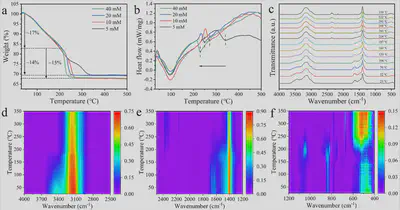
TGA/DSC curves showed that all samples exhibited two main stages of weight loss. The first stage (≈17% from 35 to 200 °C) corresponded to loss of H₂O in ABCC, with a broad endothermic peak. The second stage (≈14–15% fast weight loss) corresponded to decomposition of ABCC, with a relatively sharp endothermic peak. The decomposition temperature decreased significantly from 350 °C (5 mM) to 220 °C (40 mM), indicating that amorphous samples prepared at lower concentrations were more stable. This was consistent with the more ordered structure of low-concentration ABCC.
In-situ FTIR analysis revealed three distinct stages during heating: (1) 25–160 °C: dehydration, with gradual disappearance of O–H stretching (3440 cm⁻¹) and H–O–H bending (1613, 1660 cm⁻¹) peaks; (2) 160–200 °C: crystallization of ABCC into BCC, evidenced by splitting of CO₃²⁻ peaks; (3) 200–350 °C: decomposition of BCC into CuO. The 5 mM ABCC sample exhibited nearly identical phase transition behavior.
Crystallization Pathway of ABCC in Solution
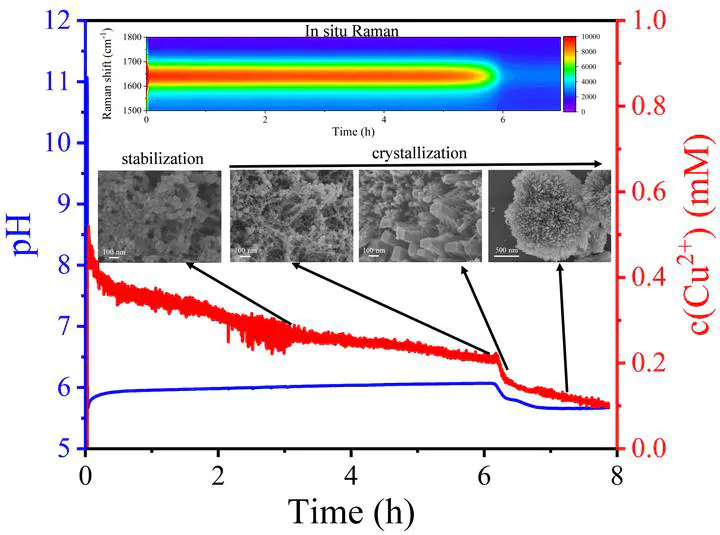
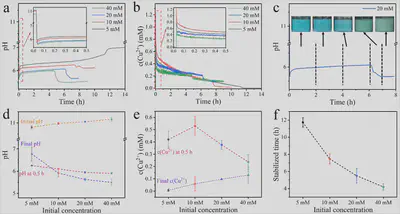
Real-time monitoring of pH and Cu²⁺ concentration revealed that upon addition of CuCl₂ to Na₂CO₃ solution, pH dropped sharply from >10.8 to ≈5.6–6.0, with instantaneous formation of blue ABCC precipitates consuming almost all OH⁻ and CO₃²⁻ ions. Subsequently, pH rose slowly while Cu²⁺ concentration decreased gradually, attributed to structural rearrangement of ABCC during equilibration. After a certain reaction time, both Cu²⁺ concentration and pH changed abruptly, with precipitate color shifting from blue to green, marking the transformation from amorphous to crystalline BCC.
Notably, at 5 mM, the pH did not decrease before increasing and then maintained as a plateau, indicating that dissolution of the metastable amorphous phase kinetically predominated at low concentrations. The stabilization time varied significantly: 11.5 h (5 mM), 7.5 h (10 mM), 6 h (20 mM), and 4 h (40 mM), demonstrating that ABCC became more unstable and crystallized more rapidly as initial concentration increased. Importantly, the crystallization kinetics of BCC were not positively correlated with solution supersaturation, contradicting classical nucleation theory.
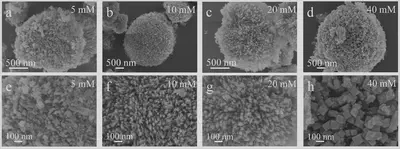
Morphology and Growth Mechanism of Crystallized Products
All final products were rough spheres composed of radially distributed nanorods, but with slight morphological differences. Nanorod diameter increased with concentration, and the 40 mM sample exhibited rectangular shapes with smooth surfaces and sharp edges, approaching the equilibrium morphology of BCC. This indicated lower supersaturation after ABCC formation at higher initial concentrations.
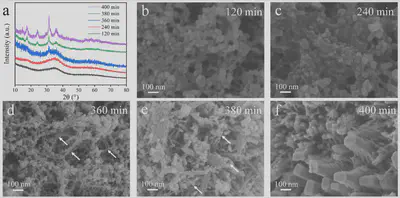
For the 20 mM system, time-resolved analysis revealed a clear non-classical crystallization picture: ABCC nanoparticles first aggregated and coalesced, then formed rod-like structures through oriented arrangement, subsequently grew via particle attachment, and finally assembled into BCC spherical aggregates. TEM and SAED confirmed direct transformation from amorphous nanoparticles to crystalline nanorods, with lattice fringes matching BCC (240) planes appearing in highly aggregated regions. HRTEM showed that amorphous nanoparticles attached to partially crystallized nanorods, suggesting nanorods transformed from these amorphous nanoparticles.
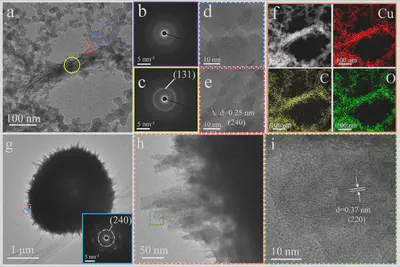
In-situ Raman Monitoring
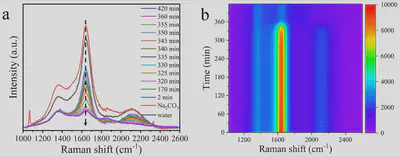
In-situ Raman analysis showed that the peak at 1064 cm⁻¹ (CO₃²⁻) disappeared 2 min after CuCl₂ addition, consistent with fast pH decrease below 7. No significant spectral changes were observed before 170 min, corresponding to stabilization of the amorphous phase. Afterward, the intensity of the peak at 1640 cm⁻¹ (H–O–H vibration) gradually weakened when ABCC crystallized into BCC, likely due to dehydration and aggregation of ABCC nanoparticles forming large BCC aggregates, reducing Raman scattering probability from water.
Stability and Crystallization Mechanism Under Different Conditions
Systematic exploration of pH, Cu²⁺/CO₃²⁻ ratio, stirring rate, and mixing method revealed that ABCC stability varied significantly under different conditions. When pH increased from 5.8 to 7, 8, and 9 (by adding NaOH), crystallization induction time prolonged from 6 h to 8 h, 2 days, and 3 days respectively, suggesting excess OH⁻ ions inhibited BCC crystal growth. However, when pH exceeded 10, the product became CuO. Varying the Cu²⁺/CO₃²⁻ ratio showed that crystallization slowed when the ratio deviated from 1:1; notably, at 1:2, ABCC remained amorphous even after 3 days. This was consistent with higher pH at increased CO₃²⁻ concentration.
Stirring speed also significantly affected crystallization: ABCC in static solution was more stable than under stirring. When stirring speed increased to 240 rpm or higher, no significant differences were observed. The sealing degree of the reactor greatly affected crystallization rate—ABCC in open reactors remained amorphous even after 3 days, due to lower CO₂ partial pressure promoting HCO₃⁻ conversion and pH increase.
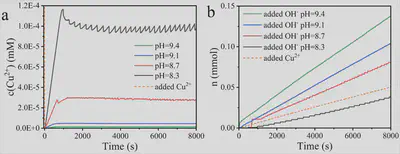
Slow titration experiments (0.02 mL/min) with pH maintained at 8.3, 8.7, 9.1, and 9.4 showed that free Cu²⁺ was several orders of magnitude lower than added Cu²⁺, indicating almost all Cu²⁺ was consumed. The composition of complexes and amorphous precipitates strongly depended on initial CO₃²⁻ and OH⁻ concentrations: at pH 8.3, Cu(OH)₂ molar fraction was less than CuCO₃; at pH ≥8.7, Cu(OH)₂ exceeded CuCO₃.
3. Summary and Outlook
In this work, the team investigated the stabilization and crystallization mechanisms of ABCC both under heating in air and in solution using various in-situ and ex-situ characterization techniques. ABCC nanoparticles with slightly different compositions and sizes were successfully synthesized at various initial concentrations, which drastically influenced their thermal stability. In solution, ABCC remained relatively stable before transforming into spherical aggregates of BCC nanorods. The crystallization process involved aggregation of ABCC nanoparticles, interfacial structural rearrangement to form crystals, and subsequent growth via particle attachment.
The team found that the stability and crystallization kinetics of ABCC are predominantly controlled by the solution environment after its formation. Specifically, the initial concentrations of CO₃²⁻ and OH⁻ ions determine the composition and structure of the ABCC precursor. A higher pH environment after ABCC formation, achieved by adding NaOH, significantly enhances its stability by inhibiting nanoparticle aggregation and rearrangement, likely through surface charge modification. Furthermore, contrary to classical nucleation theory, the crystallization rate does not correlate with solution supersaturation; instead, higher initial concentrations lead to a more stable ABCC suspension and delayed crystallization. This understanding opens avenues for designing materials with tailored properties and challenges the classical supersaturation-centric view of crystallization, offering guidance for the rational design and stabilization of functional amorphous materials.
4. Publication Information
Zikuan Wei, Qihang Wang, Jianhui Li, Feng Duan, Jilin Wang, Fei Long, Zhengyi Fu, and Zhaoyong Zou, Tuning the Stability and Crystallization Pathway of Georgeite via Solution Parameters. Advanced Functional Materials 2026, 36 (20), e10127.

Zhaoyong Zou
Professor
My research interests include bioprocess inspired fabrication, crystallization and ceramics.